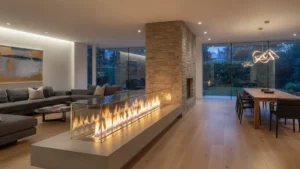
In Québec, heating with wood is governed by municipal bylaws aimed at air quality. In Montréal, a solid-fuel appliance may only be used if it is EPA- or CSA-certified and emits no more than 2.5 g/h of fine particles, and every appliance must be declared to the City. In Laval, the bylaw prohibits appliances exceeding 7.5 g/h without EPA or CSA certification, with a grant of up to $1,000 available for replacement. This guide explains the rules in force, how to check whether your fireplace is compliant, and what to do if it is not. Requirements are evolving and vary from one municipality to another, so always confirm the rules that apply to your address.
What are the regulations for wood-burning fireplaces in Montréal?
Within the City of Montréal, using a solid-fuel appliance is prohibited if it is not EPA- or CSA B415.1-certified and if it emits more than 2.5 g/h of fine particles. This rule has been in effect since October 1, 2018. An old, non-certified stove or fireplace can therefore no longer be used legally, except in specific cases.
Two clarifications frame this bylaw. First, every solid-fuel appliance must be declared to the City, whether it is used or not. Second, its use is prohibited during a smog advisory, with one important exception: during a power outage lasting more than 3 hours, any appliance may be used as emergency heating.
What does “2.5 g/h” mean in practical terms?
It is the maximum amount of fine particles the appliance can emit per hour. To put the difference in perspective, an open masonry fireplace emits on the order of 100 g/h, whereas a certified appliance stays below 2.5 g/h. The threshold is therefore intended to drastically reduce air pollution in residential neighbourhoods, especially in winter.
Do the rules change in 2026?
Requirements for wood-burning appliances continue to tighten in several Greater Montréal municipalities, and some cities are introducing new milestones in 2026. Because timelines and thresholds vary from one city—and sometimes from one borough—to another, the only reliable answer is to check your specific municipality’s bylaw before buying or continuing to use an appliance.
The underlying principle does not change: the trend is toward certified, very low-emission appliances. Investing now in an EPA- or CSA-certified appliance protects you from future tightening. Our Technical Project Managers track changes in local bylaws and confirm your project’s compliance for your address.
What are the regulations in Laval?
In Laval, bylaw L-12792 prohibits the installation and use of solid-fuel appliances that emit more than 7.5 g/h without EPA or CSA certification. To encourage upgrades, the City offers a direct grant of up to $1,000 to replace an old appliance with a compliant model.
This is a concrete opportunity: if you replace an old non-compliant stove in Laval, part of the cost may be covered. Keep your invoices and the appliance’s proof of certification, as these documents are generally required for the application.
What is a compliant, certified appliance?
A compliant appliance meets the U.S. EPA NSPS 2020 standard, in effect since May 15, 2020: 2.0 g/h of fine particles on the cordwood test, or 2.5 g/h on the crib wood test. In Québec, CSA B415.1 certification is recognized as equivalent. These two certifications are the reference accepted by municipalities.
Beyond compliance, these appliances are also more efficient. Their secondary combustion burns gases that used to go up as smoke, allowing you to get more heat with about 50% less wood. Here, compliance and efficiency go hand in hand.
How can you check whether your wood-burning fireplace is compliant?
Three checks are enough in most cases. First, find the rating plate on the back of the appliance: a certified appliance will show its emission rating and its EPA or CSA certification. Next, consult the EPA’s public list of certified appliances. Finally, if in doubt, have compliance confirmed through an inspection—especially for an appliance purchased before 2010.
Most old “slow-combustion” stoves from before the 2000s do not meet today’s thresholds. If your appliance shows no emission rating, assume it is probably not compliant and have it assessed.
What should you do if your fireplace is not compliant?
You have four options to become compliant, depending on how attached you are to a wood fire and the condition of your chimney. Each option brings emissions below the required thresholds while improving efficiency.
- Install an EPA-certified wood stove to keep the wood flame with a high-performance appliance. See our wood stoves.
- Install a certified fireplace insert in your existing masonry fireplace. Details in our wood-burning fireplace guide and the steps to replace an old stove.
- Convert to gas for heat without the hassle—allowed even in a condo. See the gas fireplace guide.
- Choose an electric fireplace, with no venting and no emissions—ideal for condominiums. See electric fireplaces.
For a condo project, the syndicate’s approval is almost always required. Our team handles these files through condo compliance upgrades.
What grants and assistance are available?
Assistance depends on the type of project. Replacing a wood-burning appliance with another wood-burning appliance is generally not subsidized in Montréal, but Laval offers up to $1,000 to replace an old appliance. For conversion projects, Hydro-Québec’s LogisVert program may apply when you replace wood heating with an electric solution or a heat pump.
Amounts and eligibility criteria for these programs change from year to year. Confirm your actual eligibility when planning your work, and keep all invoices and certificates.
What steps are required to declare your appliance?
In Montréal, declaring your solid-fuel appliance to the City is mandatory, regardless of whether it is used. This declaration allows the City to keep a registry and manage restrictions during smog episodes. Check with your borough for the exact procedure, which may vary.
During an installation or replacement, keep the appliance’s proof of certification and the documentation for a compliant installation. These documents are useful for the City, for your condo syndicate, and for your insurer.
Why do these standards exist?
Fine particles emitted by old wood-burning appliances harm air quality and respiratory health, especially during winter temperature inversions. Switching from an open fireplace to a certified appliance reduces emissions from about 100 g/h to under 2.5 g/h—a reduction of more than 97%.
The issue is real province-wide: according to Natural Resources Canada, nearly 241,000 Québec households were still using wood as a heating source in 2019. Modernizing these appliances improves both neighbourhood air quality and the performance of each home.
In the field: a successful compliance upgrade in Montréal
A family in a residential Montréal neighbourhood was still using an open masonry fireplace, which had become non-compliant and wood-hungry. Our Technical Project Managers installed an EPA-certified fireplace insert in the existing firebox, with an adapted liner. The appliance now meets the 2.5 g/h threshold, cold air no longer comes in through the chimney when the fire is out, and compliance documentation was provided to the family for insurance purposes. All without major demolition.
Does your fire ritual continue outdoors in summer? Our Mughet division designs outdoor fireplaces and summer kitchens.
FAQ: wood-burning fireplace regulations
Is my old wood-burning fireplace still legal in Montréal?
Only if it is EPA- or CSA-certified and emits 2.5 g/h or less. Non-certified appliances have been prohibited from use since October 1, 2018, except during a power outage lasting more than 3 hours.
Do I have to declare my appliance to the City?
Yes. In Montréal, every solid-fuel appliance must be declared, whether it is used or not. Check the procedure with your borough.
What are the rules in Laval?
Bylaw L-12792 prohibits appliances emitting more than 7.5 g/h without EPA or CSA certification, and the City offers up to $1,000 to replace an old appliance.
Can I still have a fire during a smog advisory?
Not in Montréal, except during a power outage lasting more than 3 hours, when the appliance may be used as emergency heating.
Which certification should I look for?
EPA NSPS 2020 (2.0 g/h on the cordwood test or 2.5 g/h on the crib wood test) or CSA B415.1, recognized as equivalent.
Need clarity for your appliance? Request a free in-home assessment: our priority is to advise and inform you.