To heat a basement with gas, two options are available: the gas stove, a freestanding appliance that radiates heat and can be installed almost anywhere, and the gas built-in fireplace, integrated into a wall for a clean look. In a basement, the choice primarily depends on possible venting, clearances, and the desired effect. Both operate with direct venting and heat efficiently. Here’s how to decide between them.
What is the difference between a gas stove and a built-in fireplace?
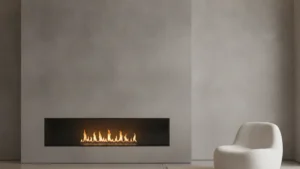
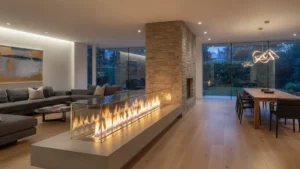
A gas stove is a freestanding appliance, placed on the floor, that diffuses heat by radiation from its sides and top. A built-in fireplace, on the other hand, is integrated into a wall or structure and features a glass facade flush with the wall. The former is more flexible to move and install; the latter offers a more discreet architectural integration.
Both burn natural gas or propane and use direct venting through a coaxial flue. See our gas stoves and our gas fireplaces category.
Which to choose for a basement?
In a basement, the determining factor is venting. A gas stove is often easier to install because its flue can exit through an exterior wall without requiring a specific wall structure. A built-in fireplace requires a wall cavity and planned venting route, ideal if you are renovating.
Also consider ceiling height, safety clearances, and the desired effect. A stove becomes a warm focal point in the center of a room; a built-in unit elegantly disappears into an entertainment wall. Our Technical Project Managers validate venting and clearances during the expert assessment.
Advantages of the Gas Stove
The gas stove excels in its installation flexibility and radiant heat diffusion, efficient for quickly warming a room. It is well-suited for a basement where one does not wish to open a wall, and it becomes a self-contained decorative element.
- Flexible installation, venting exit through an exterior wall
- Radiant heat on multiple sides
- Decorative focal point without masonry work
- Works even during a power outage
Advantages of the Gas Built-in Fireplace
The built-in fireplace offers a contemporary, flush-with-the-wall look, perfect for a renovated basement or an entertainment wall. It integrates with the finish and frees up floor space. It is the choice for discreet elegance.
- Clean and modern wall integration
- Frees up floor space
- Harmonizes with a TV or storage wall
- Direct venting planned during renovation
Gas Stove or Built-in Fireplace: The Comparison
| Criterion | Gas Stove | Gas Built-in Fireplace |
|---|---|---|
| Installation | Flexible, no wall cavity | Wall cavity + venting path |
| Aesthetics | Freestanding decorative object | Flush wall integration |
| Heat Diffusion | Radiant on multiple sides | Glass facade, frontal heat |
| Ideal for | Basement without wall renovation | Renovated basement, entertainment wall |
On-site: A Gas Stove in a North Shore Basement
For a finished basement without an available wall to open, we installed a direct-vent gas stove, with the exhaust exiting through the exterior wall. The room quickly warms up, and the stove has become the warm heart of the family space, all without masonry work.
FAQ: Gas Stove or Built-in Fireplace
Which is easier to install in a basement?
Often the gas stove, as its venting can exit through an exterior wall without a wall cavity.
Which heats better?
Both heat efficiently; the stove radiates on multiple sides, the built-in unit diffuses frontal heat.
Do they work without electricity?
Yes, most gas appliances operate during an outage thanks to battery or pilot light ignition.
Natural gas or propane in the basement?
Natural gas if the network is available; otherwise, propane with an outdoor tank.
Want to choose the right appliance for your basement? Request your free in-home expert assessment.